Motorcycle

You are currently browsing articles tagged Motorcycle.

Last Fall I purchased a Scorpion EXO 400 helmet.  It wasn’t the helmet I was hoping to get but the local motorcycle gear shops (all two of them) couldn’t get anything in my size except for the EXO 400.  The shop owner at the store I purchased it from swore up and down to me that the helmet would be quiet and comfortable.  She was right about it being comfortable.  Finding an XXXL helmet really has improved my comfort level over my old XXL melon protector.  However, the thing sounds like I have my head inside a jet engine when I ride my PC800.  Had the shop allowed me to return it (strict no-return policy once the helmet leaves the door), I would have taken it back.  But since it is was now mine, I decided to try to make some modifications to improve the noise situation.

Before you read any farther I would strongly recommend you don’t try this at home.  In fact, don’t read any farther.  It is dangerous to your health.  I’m not responsible or liable for anything you do or do not do based on what you read here.  You’ve been warned!

This is the unmodified helmet.  I put the reflective strips on (waste of money to buy the Scorpion-branded reflective strips.  Buy reflective tape and do it yourself for half the price) but otherwise the helmet is unmodified.

First I tried filling in the lock system that is used to change in and out face shields.  It helped just a little but not very much.

Next I decided the strange lightning bolt / “S” on the front of the helmet had to go.  Not only does it look silly but it could be a source of noise.

And away it goes!  Now the helmet looks much better.

The decal was held on by a few piece of double-sided tape.  I used a pair of needle nose pliers to get it off the helmet.

Next I tried using some black silicone caulking to smooth out the rough spots on the back of the helmet.

Then I got serious.  That is a whole bunch of clear silicone caulking all over the side of the helmet.  It actually has lowered the noise level noticeably.  My two theories on why it is quieter are 1) that the air flow is more laminar and 2) the extra material helps to deaden the sound reaching my ears.

The funny thing stuck to the face shield is a SuperVisor. It costs about $20 shipped and is entirely worth every penny.  I used to have issues with getting sun in my eyes on evening or morning rides.  Now I don’t have that problem.  Also it has helped to reduce the noise I get in the helmet.  I highly recommend it.

The other side of the helmet.  I’ve gotten many comments about my “ratted out” helmet and questions about the “wicked accident” I must have been in to require this “patch job.”  I smile and inform everyone that it is simply for soundproofing.

The whole helmet must look ridiculous going down the highway.  I wonder what it appears to look like when headlights wash over the side of my helmet at night.

I also put caulking between the visor and the helmet.  I was having some trouble with leaks in the rain down the front of the visor (still do but they’re less now).  Also I suspected that there was an eddy current from the wind in that little open space.

Top view of the helmet.  You can also see the four mounting tabs for the Super Visor on the face shield.  It was nerve-wracking when I put those tabs on (once you start, you either go all the way or you’ve ruined a face shield) but it was so very worth it.

As an epilogue to this soundproofing expedition I will say that the noise level hasn’t been reduced all that much by these modifications.  Yes, it is better, but the helmet is still too loud.  The biggest improvement I’ve made to date was switching from a Clearview +3 to a Clearview +5 windshield.  By no means is my setup noise-free but with those two extra inches of windshield between me and the air column, it has made an improvement.  In the fall I think it will be time to buy another new helmet.  This time I am planning to make a day trip out of riding to a bigger city where I might find a shop with XXXL helmets in stock that will let me try them out on the road before I buy.

As always, YMMV.

Tags: , , ,

Note: This project started in February and just finished at the end of May.  It took me a while to figure out where to put it, how to configure it, etc.  In retrospect, it might have been easier just to throw the whole thing in my trunk and call it good.  But hey, this approach was more fun!

First before I describe this modification to my motorcycle I should warn you: there is no reason to do this.  You can buy any number of products for under $100 that do the same job and don’t require hacking.  That said, I did it because I wanted to hack something together and be a little unique.

Disclaimer: This mod is dumb and dangerous.  You shouldn’t do it.  If you do, you might die, be horridly maimed, kill your little brother’s kitten, and destroy half of a country along the way.  The things I am doing are potentially dangerous.  Electricity is involved.  A brushed DC motor that makes sparks is involved.  This thing mounts near a gas tank where there could be vapor and fumes.  I wouldn’t recommend you try this.  DO NOT TRY THIS AT HOME.  YMMV.

At one of the local auto parts stores I found a “MidAtlantic 12 Volt Auto Air Portable Air Compressor.”  The packaging states that it is “for every tire emergency” and that it goes to “250 PSI.”  I can confirm that it will go to 250 PSI, however it will take a looooong time to get there if the volume of space you’re filling with air is large.  You can find this compressor online for less than $15.  For instance, this place sells it. No clue if that site is any good to buy from or not but you can see what it looks like in the packaging anyway

Here is a shot of the back side of the unit.  There is a LOT of dead space in the packaging where you are supposed to put the 12 foot really flimsy power cord.  This got me thinking… Why not take the case off and make the whole assembly smaller?

Here is my first view of the guts.  That little piston is TINY.  It has less volume than a shot glass.  The air intake is a little hole with a flapper valve of some sort at the top of the stroke.  There is a similar setup inside the piston to let the air out on the compression stroke.  Four screws hold the case together.  It took a little bit of time to work them out of the plastic.  They seem to be self-tapping screws.

Here it is taken halfway apart.  I can’t impress upon you enough how poor-quality the cable is that comes with the unit stock.  The switch is really, really lousy.  It fell asleep after the first time I tested it out in my car.  Good thing we won’t be needing it!

The measuring tape is so you can get an idea of the size.  This unit is SMALL.  So small in fact that it will fit between the trunk wall and the gas tank on the left side of a PC800.  Do I smell a cool bike mod?  Why, yes I do!  I should also note that it was a bit difficult to get the compressor and motor assembly out of the blue plastic case.  It was held in with a metal band that was screwed and glued down.  I ended up cutting the metal band in half to get it out.

The first step to a successful project is to do something that makes it so you can’t return the unit.  I cut off the end of the hose that came with the compressor.  An Exacto knife or box cutter should work just fine.  The inside of the hose is rubber similar to what radiator hoses are made out of.  Be careful to not let the hose braiding cover to come undone.  A bit of electrical tape can help keep it together if it is unraveling too fast.

Over at the local home improvement store I found a nice 3/16″ to 3/16″ hose barb that fit snugly into the rubber hose.  The hose probably could have fit a 1/4″ barb however the hose I found to attach to this barb wouldn’t take that large of a barb.

Using a tiny hose clamp seemed pretty reasonable to me.  After tightening it up, that rubber hose isn’t going anywhere.  On the other side of the barb I attached a 10 foot long vinyl tube.  The OD of the tube is 1/4″ and the ID of the tube is 0.170″.  The particular type of vinyl hose I found is rated for 55 PSI which is well below what this little pump is supposed be able to achieve.  However, there is NO WAY that this thing will ever reach that pressure when this thing is hooked up to a tire.  And if it does pop… well, then I learned my lesson.

This is the other end of the vinyl hose.  I put a 3/16″ hose barb to male 1/4″ NPT fitting on it.  The thing is nice and snug on there and won’t be going anywhere.

Next I attached a quick-disconnect coupling.  This isn’t strictly necessary but I figured I might as well so I have the option of disconnecting the hose from the pump to store it separately on the motorcycle.

When you take off the stock hose from the pump, this little spring and plug will pop out.  In this picture the spring/plug is flipped 180 degrees from where it should be.  Don’t lose this thing!  You need to put it back in when you’re putting the new fitting back on.

This is the assembly of parts that I put together to be able to attach a different hose to the pump.  Starting at the upper left… The fitting connection on the pump is a Schrader valve size.  It’s a real oddball and most people will have NO CLUE what it is.  It took me the better part of a day to figure it out.  I finally found a perfect-ish solution.  The local auto parts store had an “Industrial Tank Valve” that goes from 1/8″ MNPT to Schrader.  It is meant to be used on a pressure tank so that it can be drained of water or be filled with air or whatever.  If you can’t find it at an auto parts store or hardware store, try an industrial welding supply or industrial gas company.  Be sure to take out the valve core before you assemble it.

The next part is a 90 degree elbow that has 1/8″ NPT threads on each side.  Following that is an adapter to take it from 1/8″ NPT to 1/4″ NPT.  This allowed me to attach it to a quick disconnect coupler.  I put some plumbers tape on everything and tightened it all up.  The only other thing that I’d like to add to this assembly is a relief valve.  If you accidentally turn it on without a hose attached, the pump will quickly shoot past 250 PSI and put the unit in danger of explosion.  Perhaps if I can find an inexpensive valve I’ll throw it into the mix.

That valve core in the middle of the photo came out of the Schrader to 1/8″ MNPT adapter.  I was able to get it out with a pair of needle nose pliers.

Here is the assembled unit.  I also attached a simple on/off switch to the wires.  Note that you shouldn’t put a big halogen lamp close to the gauge.  I managed to warp the gauge face (a piece of plastic) due to the heat.  Oops!  To this point the entire project cost me $40.

Now comes the fun part.  I had to figure out where to mount this thing!  The first option is down by the fuel pump and gas tank.  The space is just a *little* bit too small.  Also the idea of having a brushed DC motor running next to gas tank and fuel pump made me a bit nervous.  All that space down there though got me thinking about stashing other emergency supplies there.  Perhaps there will be another post about that in the near future.

This location is marginally better but still dangerously close to a potential vapor source.  Also the brass fittings get in the way of closing the trunk.  And the gear/piston/motor exposed moving parts rub against an important-looking wiring harness.

The top of the trunk looks pretty promising.  I’d lose a little bit of storage space but gain a compressor.  Also it’s nice and close to my tire patch kit and the auxiliary fuse box.

Under the seat would be a great place except for the bottom part of the trunk.  The poor pump would get smooshed if I had it located there.  Surely there must be SOMEWHERE I can tuck this thing out of sight until I need it.  One place that I won’t put it though is in the front fairing.  There is too much heat running around up there.  Also I’m a little worried about unbalancing the front end by putting weight on one side or another.  In addition, in a crash where the front fairing might get mashed, it could take out the pump when I might need it most.  If I had a top case, I could stick it in or on that but so far I haven’t found a rear rack to mount a top case on.  Someday… someday…

Another potential place to mount it in the trunk.  If I put it here, I’d cover the moving bits with a piece of tin or plastic.  I hate to take up trunk space for this thing though.  Am really hoping I can find somewhere to put it on the bike that is not the trunk.

And then the perfect spot presented itself while I was replacing the radiator hoses… Behind the front fairing hanging off of the left mirror bracket!

The unsuspecting mirror bracket is just waiting to have something hung from it.  Poor thing.  It never knew what hit it.

The compressor zip-tied in place.  It will hold well enough for several thousand miles.  At that point I’ll probably take the fairing off again for some other upgrade or maintenance issue.

An upside-down view of the compressor zip-tied to the bracket.  The red and black wires are the power wires for the compressor.

Looking up from underneath.  The little fan might do something…  Maybe.  Yeah, probably not.

I ran the power wires back to my custom fuse block in the trunk.  Also notice the switch hiding behind the yellow wire in the top middle of the photo.  That controls the compressor.  Flip it on and the compressor starts humming away.  The switch is quite robust.  I doubt I’ll ever have a problem with it accidentally turning on.  The compressor is on its own 15 amp dedicated fuse.

I don’t have a photo of the setup for how I get a hose from the compressor to the rest of the bike just yet.  This description will have to do…  I routed the plastic tube that I had attached to the compressor around to the right side of the bike and out the right hand dash pocket/door thing that covers the radiator cap and overflow bottle.  Behind that door I put a quick disconnect fitting on the hose.  The other end of the hose with the pressure gauge and valve connector has the other side of the quick disconnect.  It is stored in my trunk for when I need it.  Having tried the whole installed compressor, I can say that it will in fact pump up a tire to the right pressure.  It is best to have your back wheel off the ground when inflating it and if you can, get your front wheel off the ground for inflating it, too.  That way you don’t run as much risk of burning out the itty bitty compressor.

In a year or so we’ll see if this configuration survived.  For under $50 though, it isn’t that bad of a setup!

Tags: , , , ,

Andrea sent me these photos to post from a bike that was resuscitated.  Here is Andrea’s explanation of the photos:

As you can see, on the first picture of the engine the leaking is coming from the front and rear cylinder just below the spark plug. It is exactly where it is located the head gasket.

The bike was sitting in a warehouse for ages, and I bought for less than $ 1,000 . I found it had a bad connecting rod bearing. Now it is perfect.

..note the sludge in the crankcase.

I hope these pictures will help…

It just goes to show that even fairly significant problems in our PC800 engines (very rare!) can be fixed with just a little effort.  Thanks for the information, Andrea!

Tags: , ,

Yesterday Karen B and I went out for a lovely Sunday ride on the Corvallis-Waldport-Florence-Monroe-Corvallis route.  The route was about 200 miles total.  Google Maps is glitching a little so the map below might not be completely accurate.

With the warm weather we both were in light jackets the entire time without problem.  The coast was a bit chilly but it wasn’t that bad as long as the sun was out.

We stopped for fuel twice.  The first stop was after 106.3 miles of driving.  I took on 2.421 gallons giving me 43.9 mpg.  The second time was after 90.5 miles where I got 1.90 gallons which gave a 47.63 mpg economy.  Also up in Newberg I bought gas after 130.5 miles for 2.978 gallons which equates to 43.82 mpg.  I’m not sure if I’m being heavier on the throttle (both of the 43mpgs were from solo riding), am riding in more city traffic conditions, or if there is something starting to go wrong with the bike.  However, the 47.63 was achieved with a passenger so who knows :-)

The bike performed flawlessly on the trip.  It is such a pleasure to ride a Pacific Coast on the Pacific Coast!

I should also mention that I put about 230 miles on the bike with two other undocumented rides.  Last week I did a quick ride around town and up Lewsiburg saddle and I also rode my bike to my parent’s house and back with a detour through Perrydale.

Tags: , , , , , , , ,

I went on a quick 50 mile ride up and over Lewisburg Saddle and through Kings Valley with my new and improved higher handlebars.  The bars are AWESOME.  I don’t know why I waited so long to get them and put them on my bike.  I still have an airhorn to install on the bike and need to decide if I’m getting highway pegs or not but it’s just about completely outfitted the way I want it.  Oh yeah, still need to trade Art in Redding for a taller windshield and find a rear rack.

Tags: , , ,

Carl and I went on a nice little weekend ride around Northwest Oregon over the weekend.  On Saturday we stopped in Newberg to wish Anne safe travels and take her on a short ride before she heads to Ukraine for two years.  We stayed the night at Rick’s house to attend one of his fabulous parties.  This morning we stopped in Sherwood to pick up Eileen and bring her back to Corvallis.

Carl at a rest stop in the mountains outside of Willamina.

My big white bike is prettier :-)

This proves that I actually was there!

In Newberg

Eileen getting dressed

Total distance: about 350 miles.

Gas stop 1: 86.2 miles (including 20 undocumented miles from Friday when I was testing the bike).  1.96 gallons.  43.98 mpg.

Gas stop 2: 101.3 miles. 1.948 gallons.  52.00 mpg.

Gas stop 3: 110.7 miles. 2.180 gallons. 50.78 mpg.

Tags: , , , , , , , , ,

Between Saturday and Sunday I went on a wild ride from Corvallis down the Pacific Coast and Redwood Highways to Point Reyes Station and back up I-5 to Corvallis.  The total distance was 1280 miles give or take.  I did the whole thing in 36 hours with 11 of those hours being used for rest in Point Reyes Station.

Originally I had planned to go over the Cascades and slip down the east side into Nevada and eventually to Death Valley.  However, due to pass conditions and an inclination to go along the coast, I went down the 101 toward San Francisco.  It’s a good thing I did because otherwise I’d be in the middle of Nevada with a bad oil leak right now.

At around Klamath, California I suddenly lost power going up a hill.  Pulling over and putting the bike up on its center stand, I found that an itty bitty oil leak on my left crank case had become a much larger leak.  It took about a quart of oil to bring my bike back up to full.  After that I was off and down the road again.

Driving through the redwoods at night on the freeway south of Eureka, California was an amazing experience.  There wasn’t one piece of straight road for probably 40 miles.  The two lanes of southbound tarmac were wide-open, beautifully marked with reflectors, and perfectly banked for 65 MPH travel.  I only saw a couple other cars on that entire stretch of road.  It felt like I was playing some retro-futuristic video game.  It was so, so awesome!

Getting gas in Ukiah, the gas station worker challenged me to an arm wrestling match.  She was in her 60′s.  In the end she relented and gave me my change.

In Petaluma I got lost and ended up driving in the wrong direction.  I had a lovely tour of the salt marshes between Petaluma and Napa though.  Finally I figured out which way was west and rode into Point Reyes Station at 330am.  It had been a long day of driving.

The next day I got out of Point Reyes Station late in the day and headed off to I-80 and then to I-5.  Somehow I missed a turn and had to go through Sacramento.  It was a good thing I did though because when I got to Redding, California, the guy at the pump behind me turned out to be a fellow PC800 owner.  He had tailed me on the freeway for 50 miles in his car waiting for me to pull over for gas so he could say hi.  It sounds like I might be going back to Redding soon to trade Art my windshield for his windshield.

Going over the pass on I-5 I was reminded how much the roads in Oregon suck at night.  It took quite a bit of concentration to stay on the road and in between the lanes.  I often tailed semi trucks to follow their brake lights.  Maybe someday Oregon will get with the program and put reflectors on the roads.

I rolled back into Corvallis at 1am.  The tip of my right thumb is still numb, my right hand is physically weak from using the clutch so much, and my right foot is numb on top.  I also lost seven pounds during that ride.  I stayed hydrated the entire time with a 100 ounce Camelback water bladder tucked in my backpack.  Who knew motorcycling was so demanding?

The parts to fix my bike are on order and should be here in a week or two.  The job will probably take about six hours to complete.  I can ride the motorcycle until then but I will be keeping it within 100 miles of friendly garages where I can park it until I can go and fix it wherever that garage happens to be.  My AAA towing plan covers up to 100 miles. :-)

I stopped for gas many different times during the trip.  The gas stops are listed below:

Waldport, OR: 139.1 miles, 3.027 gallons, 45.95 mpg (This also included the ride from Waldport to Corvallis and up Marys Peak from the day before)

Port Orford, OR: 136.6, 2.854 gallons, 47.86 mpg (Lots of wind down the coast)

Klamath, CA: 109.3, 2.352 gallons, 46.47 mpg (I was fighting some nasty winds coming down along the 101 in Oregon)

Miranda, CA: 120.2 miles, 2.687 gallons, 44.73 mpg (Too much fun on the freeway through the redwoods!)

Unika, CA: 100.2 miles, 2.105 gallons, 47.60 mpg

Point Reyes Station, CA: 137.4 miles, 2.993 gallons, 45.90 mpg

Arbuckle, CA: 140.1 miles, 2.973 gallons, 47.12 mpg (not bad for doing 75 on the freeway for most of the previous tank)

Redding, CA: 109.1 miles, 2.673 gallons, 40.8 mpg (I was doing 75 on the freeway on the whole tank to Redding.  I also had a small over-fill of a few ounces.)

Yreka, CA: 95.0 miles, 2.406 gallons, 39.48 mpg (I was pulling up the hills at 65 mph or faster out from Redding)

Grants Pass, OR: 81.3 miles, 1.816 gallons, 44.76 mpg (I went over the pass and was going slow most of the way due to poor road markings)

Cottage Grove, OR: 115.9 miles, 2.492 gallons, 46.5 mpg

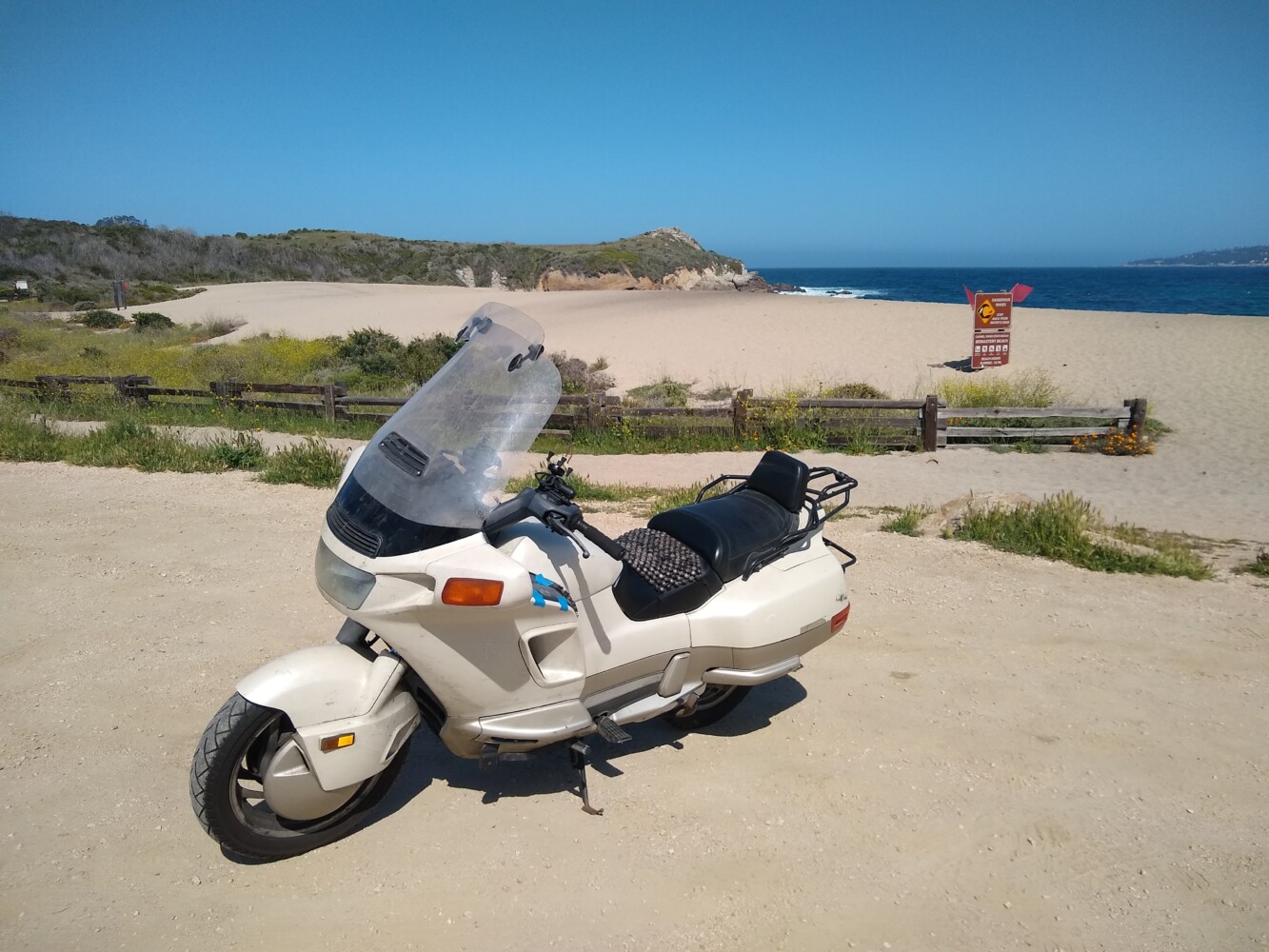
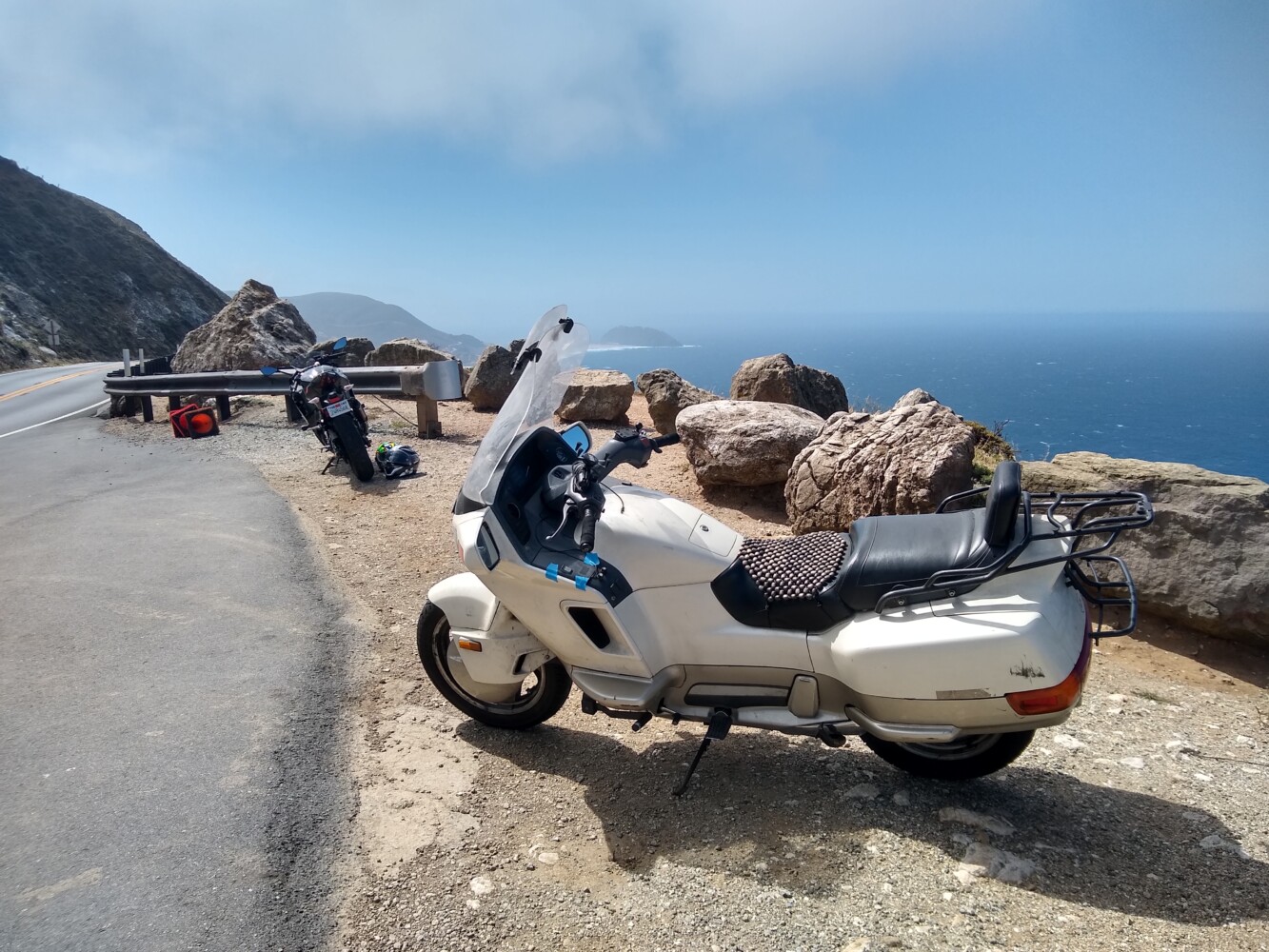
Along the Pacific Coast on my Pacific Coast

It was pretty windy through this section. A storm was rolling in.

At the California border

Where I slept in Point Reyes Station

My motorcycle with before I put the gear back on

My bike has some brake dust coming off of it. Looks like I'll be due for some new brakes soon.

The oil leak.

Gearing up for the ride north.

Sondy went on a short ride with me before I headed out of town.

Tags: , , , , , , , , , ,

Today I took Heather down to Eugene to pick up her bike from its winter storage location.  After maneuvering it out from between another motorcycle and a boat, we were off and down the road toward the coast.  We stopped at Florence to check on Heather’s bike.  It had been wobbling funny but we decided it was probably just as a result of some strange ruts in the road.

A little further north we stopped for a bathroom and stretch break before continuing to Waldport where we got gas.  The ride up to Alsea was gorgeous as always although there was a little bit of traffic that got in the way.  Up at Mary’s Peak we decided to go toward the summit but only got as far as the graveled section.  Due to some poor communication on my part, Heather turned around and I sat just beyond the gravel section like an idiot expecting her to come around the bend at any moment.  It’s probably a good thing we didn’t go up to the top though as Heather’s jacket is partially mesh and she was quickly becoming a Popsicle.

In total the ride was 256 miles.  Or maybe less.  Google Maps seems to want to make our route go through the logging roads on the west side of Marys Peak.  Ignore that deviation…

I got gas twice.  The first stop in Eugene was 2.281 gallons at 108.7 miles for 47.67 mpg, half of which was with a passenger.  The second stop was in Waldport where I took on 1.653 gallons at 89.5 miles giving me a great average of 54.14mpg.  When I’m easier on the throttle and not pounding up the twisties I get MUCH better fuel economy.  Funny how that works :-)

Tags: , , , , , , ,

Yesterday afternoon Carl and I went on a quick 66 mile ride out along Highway 180 and back.  The road wasn’t in the best shape but it was still a lot of fun.

I got gas at 113.3 miles.  2.529 gallons taken.  That gives me about 44.8 gallons per mile.  Methinks I’ve been a little lead-footed lately on the bike.

Tags: , , ,

Over the last two weeks I rebuilt the forks on my motorcycle.  After one of the seals blew out I decided it was time.  The oil inside was pretty gross even though it was only serviced a few thousand miles ago.  There is also a strange set of springs inside the forks that no one was able to identify.  Eventually I’ll post photos of the whole operation.

Also I’ve been modifying my helmet to make it quieter.  It’s getting better but still not great.  Next step is to put a sun visor on it and see how that works.  Photos of that eventually, too.

Tags: ,

« Older entries