Masters Thesis

You are currently browsing articles tagged Masters Thesis.

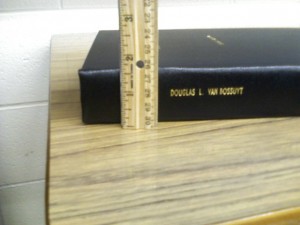
My thesis is officially bound, signed, and delivered. Now I just have to wait until the middle of April to be able to pick up the piece of paper that says I finished and graduated. It still boggles my mind that this thing turned out to be nearly 2 inches thick.
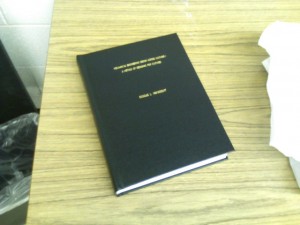
Masters thesis on a desk

Masters thesis bound and ready for delivery.

Masters thesis spine thickness

Masters thesis spine thickness

Tags: ,

As far as I know, this is the final version of my Masters Thesis. Everyone has signed off except for the graduate school dean. That signature should come shortly.

I have already started doing background research for my PhD. The topic will be broadly based on risk and reliability engineering, trade-spaces, margin trading, cultural differences, and other such fun stuff. My new major professor, Dr. Irem Tumer, is finishing up a multi-university funding proposal to get everything setup for the next few years. At this point it all sounds rather exciting!

Tags: , , ,

Hopefully this is my last (or nearly last) thesis draft.  I am now down to finding any mistakes in my LaTeX code and correcting them.  The content is pretty well fixed.  What do you all think?  Are there any major errors I have to correct before I send it to the printer?

Tags: , , , ,

Yup, that’s right.  I passed my thesis defense!  There are some small changes to make in my thesis, an appendix to add, and copies to print off.  Then it’s signatures, a library copy, and picking up my diploma.

More details about the defense will be forthcoming.

Tags: , , ,

Addressing Cultural Factors in Mechanical Design

By Douglas Lee Van Bossuyt

Candidate for Master of Science in Mechanical Engineering

Oregon State University

Abstract

Mechanical design is often based on formal methodologies such as Quality Function Deployment (QFD). Techniques to quantitatively account for qualitative design factors such as attractability, sensory perception, and affective customer response have been successfully incorporated into these methodologies and are receiving growing acceptance across many industries. In today’s global economy, however, further work is needed to address the challenge of moving designs across cultural boundaries and facilitate the transfer of products to diverse and culturally distinct consumer groups.  This presentation describes one approach to quantitatively addressing cultural factors in the design process.

Monday, December 29, 2008

10:00 am, Rogers 226


osu-logo

School of Mechanical, Industrial, and Manufacturing Engineering

Tags: , , , ,

Masters Thesis Draft

I finished my Masters Thesis draft last night. It’s still pretty rough and will be beat into shape this week. I had to get it out the door for my committee to read over before next Monday’s defense.

Tags: , , ,

While writing my thesis, I found need to include several tables.  The standard table package included in LaTeX sucks.  Doing some research, I found that the booktabs package is far superior and produces truly beautiful results.

It can be called by inserting this code:\usepackage{booktabs}

The following links are for later use:

Here is an example of a table I created.  Note that the “textwidth” variable is defined in my class files.

\begin{table}
\caption{GLOBE Cultural Clusters \cite{GLOBE04}.}
\begin{center}
\begin{tabular}{l p{0.6\textwidth}}
\toprule
Cluster & Cultures \\
\midrule
Confucian Asia & Singapore, Hong Kong, Taiwan, China, South Korea \\
\\
Southern Asia & Philippines, Indonesia, Malaysia, India, Thailand, Iran \\
\\
Latin America & Ecuador, El Salvador, Columbia, Bolivia, Brazil, Guatemala, Argentina, Costa Rica, Venezuela, Mexico \\
\\
Nordic Europe & Denmark, Finland, Sweden \\
\\
Anglo & Canada, USA, Australia, Ireland, England, South Africa (White Sample), New Zealand \\
\\
Germanic Europe & Austria, The Netherlands, Switzerland, Germany-East, Germany-West \\
\\
Sub-Saharan Africa & Zimbabwe, Namibia, Zambia, Nigeria, South Africa (Black Sample) \\
\\
Eastern Europe & Greece, Hungary, Albania, Slovenia, Poland, Russia, Georgia, Kazakhstan \\
\\
Middle East & Turkey, Kuwait, Egypt, Morocco, Qatar \\
\bottomrule
\end{tabular}
\end{center}
\label{table:cultural_clusters_GLOBE}
\end{table}

Tags: , , , ,

After adding about 30 scanned images into an appendix, I started getting “too many unprocessed floats” errors.  Doing a little digging, I found that many of the images were starting to back up on each other.  LaTeX was getting plugged up and was barfing.

The solution:

Add this to your top-level file:

\usepackage[section] {placeins}

By using the placeins package with the section option selected, LaTeX is forced to dump all of the unprocessed floats at the end of each section.  There are a few other ways to do it with that package but this way made the most sense to me.  Doing that, I get no more errors!  Well, at least from that problem.

Tags: , , ,

I’m authoring my thesis in LaTeX, a sort of scripting language similar to HTML that produces beautiful final results… that is, if you can get it to cooperate.

My current problem is with trying to use the graphicx package.  I can’t get a graphic to display correctly.  The code looks correct but it keeps throwing strange errors.  I copied the code verbatim (with changing the file i’m trying to insert) from a friend’s masters thesis.  It worked in his so I don’t see why it’s not working in mine.  We are using the same class files and whatnot and the same general format.

The problem comes (i think) in the width variable.  That textwidth doesn’t seem to be working correctly.

The Code:

\begin{figure}[h]
\begin{center}
\includegraphics[width=0.6\textwidth, keepaspectratio=true ]{figures/hofstede_onion.png}
\caption{Hofstede's Onion Model of Culture: Cultural Values are located at the core and are surrounded by Rituals, Heros, and Symbols with Practices drilling down from the outside to the Values center. Reproduced from \cite{Hofstede01}.}
\label{fig:hofstede_onion}
\end{center}
\end{figure}

The Error Message:

! LaTeX Error: Cannot determine size of graphic in figures/hofstede_onion.png (no BoundingBox).
See the LaTeX manual or LaTeX Companion for explanation.
Type H for immediate help.
...
1.18 ... ctratio=true ]{figures/hofstede_onion.png}
) [5]

Thoughts, insights, ideas?

UPDATE:

With the help of Alex (recommended by Anne), I was able to get the graphics files to pop out.  The key was switching from outputting into a DVI file or a PS file to outputting directly into a PDF file.  To do this in TeXnic Center, I went to Build -> Select Output File.  I then chose the PDF option.

Other problems still exist with my output, but at least some of the big ones are now addressed.  No doubt, there will be further whining for help as I progress with my thesis.

Tags: , , , ,

School starts for me in another 20 minutes.  This will probably be the last term I have a normal, fully-loaded schedule that includes academic coursework.  While I am only taking two classes, my thesis work, applying for PhD programs, writing journal articles, and taking the GRE are keeping me quite busy.

In general, I really enjoy being busy and productive.  However, the last month or so I’ve been so busy with working 60 to 80 hours a week on all of my academic work, I haven’t hardly had any time to go out and play.  No SCUBA diving for almost a month.  No motorcycle riding for several weeks.  No mountain biking all summer!  Not even rock climbing.

At least I updated my CV again.  This time, I added in some information about a forthcoming journal article and a conference panel I sat on last year.  I also included my membership in PADI and the American Academy for Underwater Science Standards (AAUSS).  That reminds me… I really need to fill out my AAUSS logs for August and send them in soon.

Tags: , , , , , , , ,

« Older entries